Sam Sachdeva | 23 June 2025
The signing of the UK-NZ trade deal was ‘just the start of the journey’, official says after update to reduce wine barriers
New Zealand wines now have a smoother pathway into the United Kingdom, with one British official saying the changes show the value of the “living, growing” trade deal between the two countries.
Government officials and ministers from both countries met in London last month for the joint UK-NZ ministerial trade committee set up to monitor the free trade agreement signed in 2022.
Following the committee meeting, the UK formally agreed to accept exports of New Zealand wine made using ammonium chloride, agar, alginic acid, and potassium ferrocyanide (used to adjust the stability, clarity and acidity of wine).
Frazer MacDiarmid, the British High Commission’s lead trade policy adviser, told Newsroom the winemaking changes were a good example of the trade deal’s status as a “living, growing agreement”.
“The perception is that once you’ve signed, that the deal’s done, you never even think about it again … but certainly from the UK perspective, and I think it’s shared by the New Zealand government, that’s actually just the start of the journey.”
MacDiarmid said the annual committee discussions were a chance to assess the success of the deal, reflect on feedback from businesses, and think about what changes could be made in response.
The deal had been largely well received in the UK, with concerns from some about New Zealand lamb imports flooding the market not borne out by trade statistics.
After formally leaving the EU in early 2020, the UK had needed to quickly get a handle on trade policy and negotiations, and had looked to New Zealand as a “key partner for how trade is done”, MacDiarmid said.
 “It’s been quite a collaborative relationship with New Zealand, to the level of exchanging notes about how different negotiations are going, and different negotiation tactics for different FTAs that we’re hoping to get with other partners.”
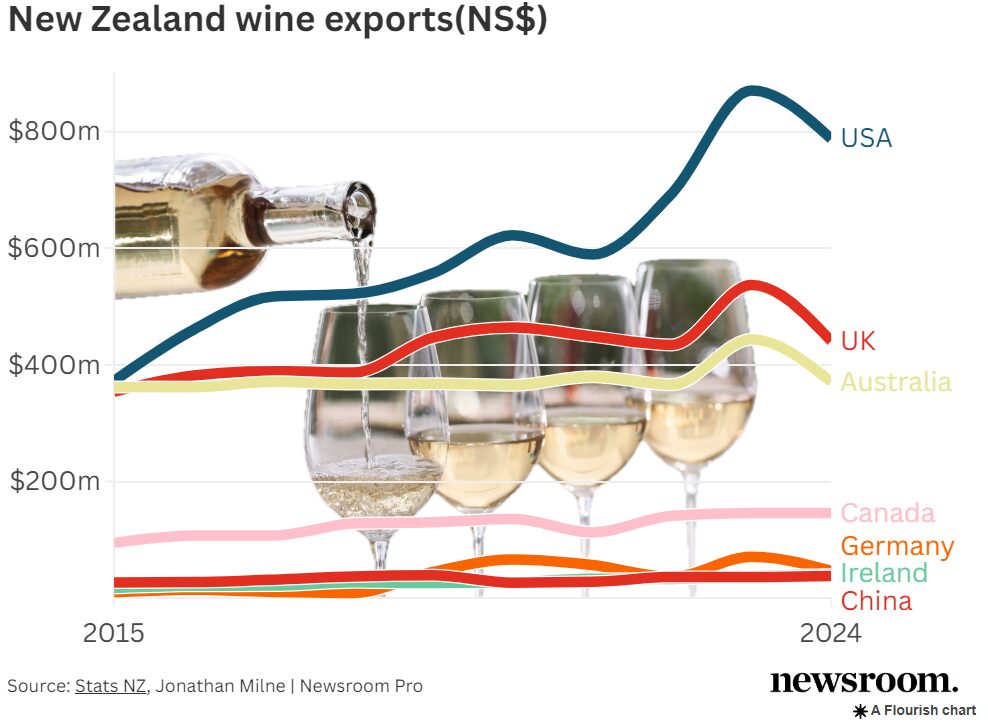
NZ Winegrowers general manager for advocacy Sarah Wilson told Newsroom closer regulatory alignment between the two countries was good news for winemakers sending their product to their second-largest export market.
Wilson said the original trade deal had also allowed for greater flexibility on labelling and other winemaking practices for New Zealand wine headed to the UK.
The sector would also support the UK joining the World Wine Trade Group, a government-industry partnership set up to remove trade barriers, as that would lead to “full mutual acceptance” of winemaking practices between the two countries.
Trade and Investment Minister Todd McClay told Newsroom the UK’s decision was a good example of how high-quality trade deals could deliver value beyond tariff reductions.
“This is exactly what the NZ-UK free trade agreement was meant to do – remove trade barriers, support regulatory alignment, and make it easier for exporters to get their products to market.”
Wine exports to the UK were worth $426 million this year, and McClay said aligning winemaking standards would give local producers greater flexibility to use modern techniques while maintaining market access and growing trade.
“The UK’s move shows confidence in New Zealand’s production systems and highlights the kind of trust-based, practical trade relationships we’re focused on – ones that deliver real outcomes for exporters.”
British High Commissioner Iona Thomas told Newsroom the changes showed the trade deal wasn’t “just a one-off piece of paper” but an ongoing, active partnership between the two countries.
“The annual joint committee, and the work that our policy teams do week in, week out, is where we turn the ambition of the agreement into action,” Thomas said.
“The work that goes on behind the headlines ensures the deal delivers real benefits for businesses, consumers and communities on both sides of the world.”