Here’s a summary of the July 2026 newsletter for The Cellar Club Inc:
Club Mid-Year Dinner
Event: Mid-Year Dinner at The Johnsonville Club, Vista Cafe, Wellington.
Date/Time: Arrive at 6:30pm for dinner at 7pm.
Details: B.Y.O. event—members are encouraged to bring wine from their own cellars. The club is subsidizing the buffet cost (members pay $55) and providing bubbles on arrival. The venue is local due to the current fuel crisis.
Transport: Public transport options (train and bus) are available nearby. There are 50 parking spaces after 5pm, but carpooling or public transport is encouraged.
Recent Event Recap
Margrain Vineyard Tasting: Hosted by Kate Throp, featuring several Margrain wines. The event was well-attended (29 members) and included discounted wine sales.
Wines Tasted: Margrain La Michelle Methode Traditionelle, Pinot Gris, Riesling, Chenin Blanc, Chardonnay, Rivers Edge Pinot, and Home Block Pinot.
Upcoming Events
Margrain Cellar Dwellers Tastings: Special tastings of aged wines in August and September. No bookings required; $25–$30 per person.
August: Riverby, Marlborough tasting.
September: Likely a focus on wines of Argentina.
October: J K Wines.
Club Updates
Bottle Tops Collection: The club has stopped collecting bottle tops; members are encouraged to use supermarket recycling. The last collection raised $132.60 for The Kidney Kids organisation.
Membership Subscriptions: Now due for the year starting July 1 ($25 per person). Payment can be made via bank transfer or in cash to Wayne Kennedy.
Here’s a summary of the June 2026 newsletter from The Cellar Club Inc.
June Event: Margrain Vineyard Presentation
Date & Time: Wednesday, 10th June, 8pm
Presenter: Kate Throp, Margrain’s Cellar Door/Sales/Marketing/Admin lead
About Margrain: A family-owned vineyard in Martinborough, established in 1992, known for its commitment to quality and a complete vineyard experience (tastings, tours, accommodation, and dining).
Wines Featured: La Michelle Methode Traditionelle, Pinot Gris, Riesling, Chenin Blanc, Chardonnay, Rivers Edge Pinot, Home Block Pinot.
Extras: Cellar Door open daily, kitchen open Wed–Sun, vineyard tours, and accommodation available.
Club Updates
May AGM Recap:
All committee members remain for another year.
Subscriptions stay at $25 for 2026/27.
Wayne Kennedy was unanimously made a Life Member.
Financial and President’s reports are on the club website.
Screwcaps Collection:
The club will stop collecting screwcaps after the AGM.
Members can bring any remaining screwcaps to the June meeting for donation to Kidney Kids NZ.
For recycling locations, visit recyclemap.co.nz.
Looking Ahead
July: Proposed Mid-Winter Dinner at The Johnsonville Club; members’ attendance feedback requested.
August: Margrain, Wairarapa event.
September: To be confirmed.
Wine News
Bell Hill (Canterbury) Named NZ Winery of the Year 2026 by The Real Review.
Recognized for consistency and excellence.
Other top wineries: Felton Road (runner-up), Prophet’s Rock, Quartz Reef, Bilancia.
Special awards for Cloudy Bay, Neudorf, Burn Cottage, Chateau Garage, Greywacke.
Rising Stars: Jascha Oldham-Selak and Sanne Witteveen.
2024 Craggy Range Martinborough Pinot Noir (Champion Pinot Noir Trophy)
Recent Club Activity
Penfolds Evening: Members recently enjoyed a prestigious tasting led by Wayne Kennedy. The 2012 Penfolds Bin 9 Cabernet Sauvignon was voted the highlight of the night.
Tribute: A glass was raised to late club member Mark Haythornthwaite, featuring a Pinot Noir from his own vineyard.
Industry News & Community
Big Sky Wines: A featured article describes the community-driven harvest at Big Sky Wines in Te Muna Valley, where owners Kath Jacobs and Jeremy Corban utilize friends and neighbors to hand-pick grapes for their organic winery.
Charity: The club continues to collect screwcaps for Kidney Kids NZ.
Future Meetings: The AGM is scheduled for May, followed by a presentation from Foxes Island in June.
Key takeaways from the January 2026 Cellar Club newsletter.
February Tasting: Askerne (Hawke’s Bay)
Event: Askerne tasting with Co‑Founder John Loughlin.
Date: Wednesday 11 February, 8pm.
Venue: Clubrooms.
Background: Askerne has grown from an 11.6ha family venture (est. 1993) into a diverse producer with a long history of award‑winning wines and evolving styles.
Notable history:
Early plantings from 1993–1996.
First cellar door opened in 1997.
Multiple gold medals and trophies through the 2000s.
New Icon series launched in 2018–2019.
Continued innovation through 2020–2021.
December Christmas Dinner Recap
Venue: Le Cloche.
Experience: Excellent food, friendly staff, and a relaxed evening across three large tables.
Menu highlights: Bubbles on arrival, amuse‑bouche, salmon terrine, choice of fish or duck, and a standout chocolate‑and‑red‑fruit dessert.
Member feedback: Very positive, especially about the dessert.
Wine News Highlights
Swift Wines (Hawke’s Bay):
New colourful cellar door on Mere Rd.
Build‑your‑own platter system and six‑wine tasting.
Sales of New Zealand wine have increased in the US – “a bright spot in an otherwise declining import sector”, the New Zealand Winegrowers industry body says.
The increase, for 2024, marks the sixteenth year in a row that retail sales of New Zealand wines within the US have gone up, the new report from alcohol sales analysts Impact Databank. And it comes on the heels of threats from US president Donald Trump to impose a 200 percent tariff on alcohol imported from European Union countries, amid unfolding international trade tensions.
New Zealand Winegrowers director Fabian Yukich told Morning Report it was promising news, amidst otherwise challenging conditions.
“That publication goes out to a lot of people who make decisions about buying New Zealand wine, so it’s pretty important … that we’re getting all this good news from the US right now, where things are otherwise a bit gloomy in other parts of the industry … people see it and they say, well we better order some more New Zealand wine,” Yukich said.
New Zealand is particularly known for the “flavours and aromas” of our sauvignon blank, he said.
“If you look at it from a global perspective, we are less than 2 percent of the world’s production – the trend at the moment is moving away from red wines and towards white wines, and it’s moving towards those more aromatic fresh white wines, so the trend is all in New Zealand’s favour.”
“So the wine’s that we make they are also very sustainably made, and we do take a lot of time to promote that around the world, and that is also in our favour because people do like to buy wines that are sustainably produced.”
Yukich said despite retail sales in the US increasing, retailers were being slow to restock New Zealand wine on their shelves, “and we are feeling that a little bit in New Zealand.”
“They’re unstocking – so that means less sales in the short term … less imports from New Zealand at the moment … but the outlook in the long term is good. Just about every other country’s sales at retail level are reducing, and wine in general is reducing – against that backdrop New Zealand wine is increasing … the long term picture is good.”
Picking has just begun for this season’s sauvignon blanc, but in the face of declining consumption in New Zealand and international, some growers in Marlborough have recently been advised to leave some of their crop unpicked.
“In the last three years we’ve had three massive crops, that Mother Nature has delivered – and this year’s no different to 2022 and 2023, where the vines are delivering a lot of grapes,” Yukich said.
“And the wine companies are saying ‘well look, we need to temper that against what is actually being exported out of the country’.
“It’s not great news for our growers… but the long term outlook is good.”
From experiential marketing to bright whites, 2025 is set to see trends prioritising wellness, innovation and sustainability, according to a report by AF&CO.
As we look ahead to wine in 2025, the industry is undergoing a transformation driven by shifting consumer preferences, climate challenges, and generational tastes. From low-alcohol wines to experiential offerings, here are the trends that will define the year ahead, based on insights from the AF&CO + Carbonate Trends Report 2025.
Chenin Blanc leads the charge in bright whites
White wines are poised for continued growth in 2025, outpacing reds globally. Beyond mainstays like Sauvignon Blanc and Pinot Grigio, under-the-radar varieties are gaining attention. Chenin Blanc is emerging as a standout, combining the crispness of Sauvignon Blanc with Chardonnay’s complexity, making it both versatile and age-worthy.
In the Loire Valley, where Chenin Blanc thrives, producers predict its plantings will surpass Sauvignon Blanc, thanks to its resilience in a warming climate. Bourgueil, traditionally a red wine appellation, has begun lobbying for a high-quality designation for its Chenin Blanc wines, signalling the grape’s resurgence. Across the Atlantic, California winemakers and Washington’s Chateau Ste. Michelle are spearheading a revival of Chenin Blanc in the United States, further broadening its appeal.
Innovative whites such as White Malbec from Argentina and White Pinot Noir from Oregon are also reshaping the category, offering fresh, unexpected options for adventurous drinkers.
Low-alcohol wines for wellness-conscious consumers
Health and wellness trends continue to influence the wine industry, with low-alcohol wines gaining momentum. Brands such as Duckhorn, Kendall Jackson, and Kim Crawford have introduced reduced-alcohol ranges to appeal to health-conscious consumers seeking moderation without sacrificing flavour.
Similarly, Chilean wine brand Casillero del Diablo, owned by Concha y Toro, has launched its first alcohol-free wine in the UK market with the introduction of a de-alcoholised sparkling wine.
The trend aligns with the broader movement towards mindful drinking, as consumers increasingly look for wines that complement their lifestyles.
Alternative formats and sweet wines
Cans, magnums, and other packaging formats are resonating with younger consumers prioritising convenience and sustainability. Additionally, sweeter wines with lower alcohol are successfully drawing in new drinkers. Inspired by global flavour trends, these approachable wines tap into the popularity of sweet and spicy combinations, broadening wine’s appeal to diverse audiences.
Experience-driven consumption
Wineries are moving beyond traditional tastings to create immersive, memorable experiences. Younger generations, particularly Gen Z and Millennials, are drawn to events where wine is part of a larger narrative. From art installations to retro-inspired social hours, wineries like Bella Union in Napa Valley are aiming to engage younger consumers through unique on site tasting spaces, and features like outdoors after hours bars.
Sustainability and adaptation
Sustainability remains a critical focus as climate change impacts vineyard management and consumer priorities. The shift towards resilient grape varieties, such as Chenin Blanc, reflects efforts to adapt to changing growing conditions. At the same time, eco-friendly packaging and practices are increasingly integral to marketing strategies aimed at environmentally conscious consumers.
Pinot noir is a beloved wine variety in NZ, favoured for its elegantly balanced fruit, florals and lithe profile. It’s an elegant wine so is easy to love – but hard to grow, hence being nicknamed the ‘heartbreak grape’. Its thin-skinned and susceptible to disease, so it took brave wine-making visionaries to attempt to grow pinot here in NZ. Early champions of the wine were told that they were mad.
Luckily for pinot lovers, one such ‘madman’ didn’t listen. Irishman Alan Brady came to Central Otago and planted pinot on a small plot in Gibbston Valley, despite people telling him repeatedly it would had produced the first modern commercial pinot noir in 1973 from Canterbury-grown grapes).
There was no looking back and pinot planting in the region surged from less than 150ha in 1990 to 2000ha by the year 2000. Alan is respected as the godfather of NZ pinot noir and at almost 90 was present at the recent Pinot Noir Conference in Christchurch still with a thirst for knowledge and the desire to share what he has learned along the way.
The three-day event was an opportunity to be inspired by the NZ pinot noir journey and to plan the future for this exciting wine variety.
Today, NZ’s pinot plantings exceed 5700ha. Pinot noir grapevines like a cool climate and thrive in all wine regions from the Wairarapa south as well as in higher altitude regions of Hawke’s Bay. The largest concentration of plantings is in Marlborough.
There is no question that pinot noir is NZ’s most important red grape, so making this wine well represents a level of skill in growing and wine-making that not all wine regions are capable of, regardless of climate. It truly is a reflection of just how special NZ wine is and we want the world to know.
July is your Club’s mid-year dinner. This July it is to be held at Le Bouillon Bel Air Restaurant in Tory Street, Wellington CBD.
The event cost is $85 per person, and there will be Club bubbles on arrival at the restaurant as usual.
You are encouraged to bring your partner – even if they are not a Club member, they are more than welcome to come along to both your club’s meals.
This July’s meal is a good time to get out those French wines that you have in your wine cellars to share with friends at the meal.
We don’t have the menu at this stage, as the restaurant changes its menus every two months, so you get variety and season’s pickings all through the year. We won’t know the menu until it comes out on 23rd June, but please look at the present menu for a sample of what they offer to patrons.
There will be a notice sent out separately that will detail the new menu and payment details. This will require a response by July 4th.
Please read an article featured in Cuisine magazine: Le Bouillon Bel Air – Cuisine Magazine – From New Zealand to the World: “Princely dining for Paupers – Entering Le Bouillon Bel Air one finds oneself set down in a fancy Parisian restaurant, circa 1895. A bow-tied, black-waistcoated waiter leads you past mirrors decorated in the same sinuous Art-Nouveau style as the pierced wooden room divide…. The menu, too, is inspired by Chartier, so rather than being subjected to culinary experimentation as a paying lab rat, expect a comforting sense of tradition.”
The signing of the UK-NZ trade deal was ‘just the start of the journey’, official says after update to reduce wine barriers
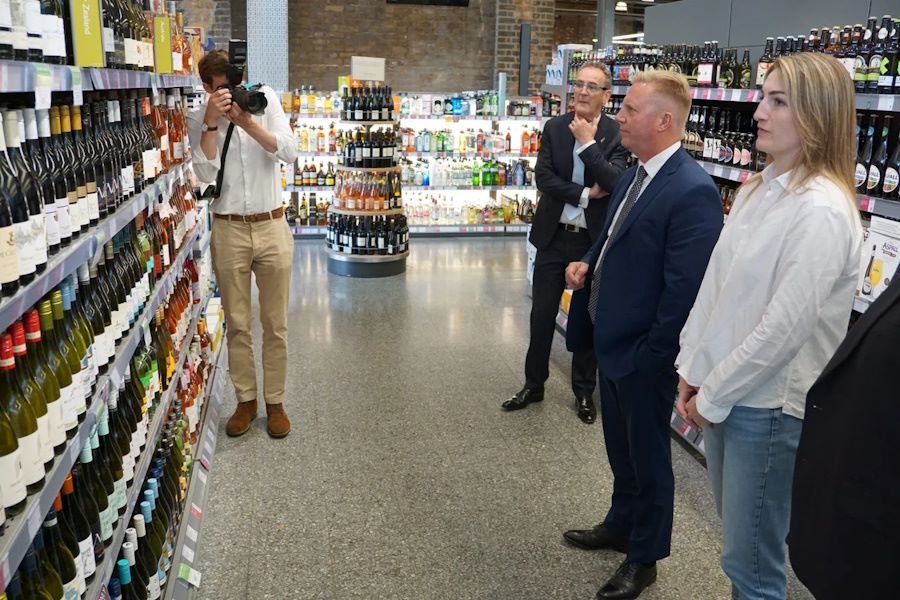
Trade and Investment Minister Todd McClay examines New Zealand wines on sale in a London supermarket. Photo: Supplied
New Zealand wines now have a smoother pathway into the United Kingdom, with one British official saying the changes show the value of the “living, growing” trade deal between the two countries.
Government officials and ministers from both countries met in London last month for the joint UK-NZ ministerial trade committee set up to monitor the free trade agreement signed in 2022.
Following the committee meeting, the UK formally agreed to accept exports of New Zealand wine made using ammonium chloride, agar, alginic acid, and potassium ferrocyanide (used to adjust the stability, clarity and acidity of wine).
Frazer MacDiarmid, the British High Commission’s lead trade policy adviser, told Newsroom the winemaking changes were a good example of the trade deal’s status as a “living, growing agreement”.
“The perception is that once you’ve signed, that the deal’s done, you never even think about it again … but certainly from the UK perspective, and I think it’s shared by the New Zealand government, that’s actually just the start of the journey.”
MacDiarmid said the annual committee discussions were a chance to assess the success of the deal, reflect on feedback from businesses, and think about what changes could be made in response.
The deal had been largely well received in the UK, with concerns from some about New Zealand lamb imports flooding the market not borne out by trade statistics.
After formally leaving the EU in early 2020, the UK had needed to quickly get a handle on trade policy and negotiations, and had looked to New Zealand as a “key partner for how trade is done”, MacDiarmid said.
“It’s been quite a collaborative relationship with New Zealand, to the level of exchanging notes about how different negotiations are going, and different negotiation tactics for different FTAs that we’re hoping to get with other partners.”
NZ Winegrowers general manager for advocacy Sarah Wilson told Newsroom closer regulatory alignment between the two countries was good news for winemakers sending their product to their second-largest export market.
Wilson said the original trade deal had also allowed for greater flexibility on labelling and other winemaking practices for New Zealand wine headed to the UK.
The sector would also support the UK joining the World Wine Trade Group, a government-industry partnership set up to remove trade barriers, as that would lead to “full mutual acceptance” of winemaking practices between the two countries.
Trade and Investment Minister Todd McClay told Newsroom the UK’s decision was a good example of how high-quality trade deals could deliver value beyond tariff reductions.
“This is exactly what the NZ-UK free trade agreement was meant to do – remove trade barriers, support regulatory alignment, and make it easier for exporters to get their products to market.”
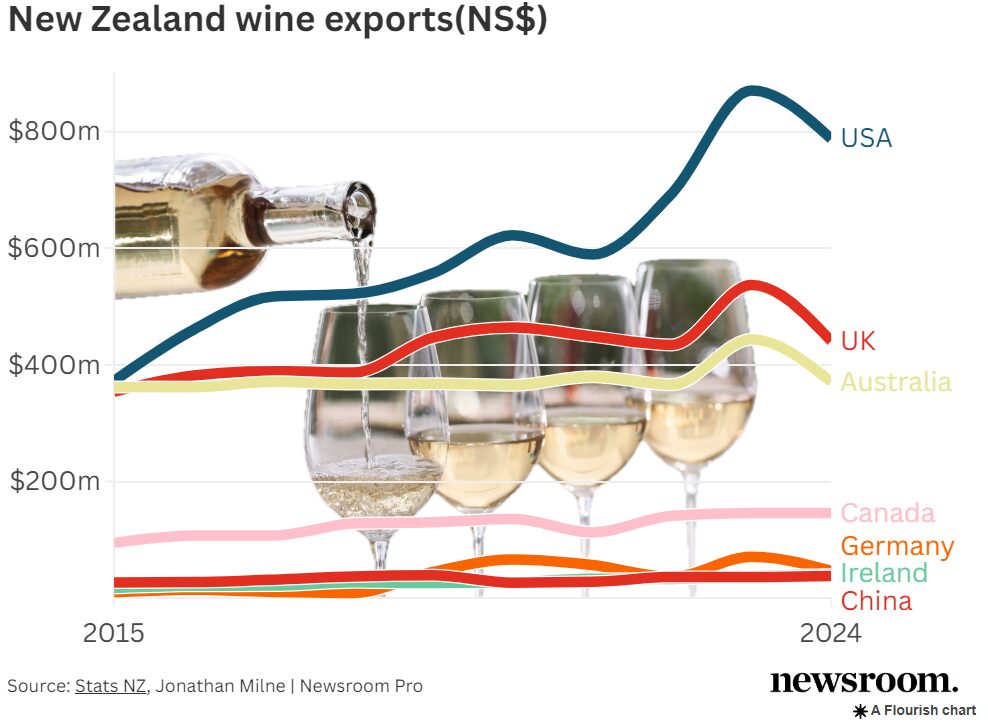
Wine exports to the UK were worth $426 million this year, and McClay said aligning winemaking standards would give local producers greater flexibility to use modern techniques while maintaining market access and growing trade.
“The UK’s move shows confidence in New Zealand’s production systems and highlights the kind of trust-based, practical trade relationships we’re focused on – ones that deliver real outcomes for exporters.”
British High Commissioner Iona Thomas told Newsroom the changes showed the trade deal wasn’t “just a one-off piece of paper” but an ongoing, active partnership between the two countries.
“The annual joint committee, and the work that our policy teams do week in, week out, is where we turn the ambition of the agreement into action,” Thomas said.
“The work that goes on behind the headlines ensures the deal delivers real benefits for businesses, consumers and communities on both sides of the world.”
They’re too small, inhibit flavour appreciation and, according to one sommelier, should be ‘outlawed’. But what are the better alternatives?
The Telegraph consulted wine experts to find out the dos and don’ts of drinking champagne Credit: Haarala Hamilton
Maximilian Riedel has a mission: to rid the world of champagne flutes. “My goal is to make them obsolete within my lifetime,” says the 11th-generation glassmaker from Austria. “Champagne and sparkling wines deserve to be shown at their very best. A narrow flute does nothing for them.”
He is not alone in the charge against the tall, slender vessel – or in his determination to see wine glasses replace them. With 70 per cent of our perception of flavour coming from aroma, Riedel argues, the more open shape, whether a traditional white wine glass, a tulip-shaped one or bigger burgundy glass, enables the wine to be appreciated fully.
Acclaimed publican Heath Ball ditched “hundreds of flutes” when he took over The Angel in Highgate, London, in November 2024 – though he has reluctantly held a few back “because some people do like them and I hate to say no”.
At The Angel in Highgate, Heath Ball has largely dismissed flutes in favour of wider glasses
They should be “outlawed” insists sommelier Sandia Chang, who founded the online grower-champagne shop Bubbleshop and runs the two-Michelin-starred Kitchen Table restaurant in the capital with her chef husband James Knappett. And there’s not a flute in sight on the champagne trolley at the luxurious Grantley Hall near Ripon in North Yorkshire.
Flutes have been the go-to glass for champagne ever since – so legend says, and Riedel reports – 18th-century Benedictine monk and abbey cellarman Dom Pérignon said he liked to “watch the dance of the sparkling atoms” in a slim glass. As champagne became a drink associated with celebration, the flute contained a measured serving just right for a toast.
But sparkling wine is increasingly appreciated as a versatile, food-friendly drink worthy of more than just chin-chin moments at weddings. “We’re seeing more and more people drink sparkling wine just as they would a still wine,” says Ball. “And when you shift it from the flute [into a wine glass] it becomes more relaxed and more enjoyable. I’m all for that.”
So if flutes are out, what should you pour your next glass of fizz into?
A white wine glass
“All sparkling wines are better enjoyed in wine glasses rather than flutes,” argues Chang. “Flutes may look pretty but it’s almost impossible to appreciate the aromas of the wine without getting just bubbles up your nose.” And no, the flute’s shape doesn’t necessarily keep bubbles bubblier for longer: “A well-made sparkling wine will not lose its bubbles during the time it takes to drink a glass,” she says.
Sommelier Sandia Chang argues that sparkling wines are better suited to a white wine glass than a flute
The bowl of a white wine glass allows aromas and flavours to develop, and acidity to become balanced. “The wine looks good,” says Ball, “it’s better value for the customer, and more relaxed and contemporary.”
It’s more generous too. At The Angel, Ball will pour Château Palmer champagne or Australian lambrusco into an elegant wine glass as a 175ml serving, rather than the 125ml typically held in a flute. “With flutes, you fill the glass, then two sips later it’s all over. Where’s the fun in that?”
The universal shape of a white wine glass makes it a practical choice, a consideration even for a top sommelier like Isa Bal, co-owner with chef Jonny Lake of Trivet, the two-Michelin-star restaurant in Bermondsey. At home he keeps things simple – and saves space – with one set of glassware for all wines, including champagne: “A white wine glass does the job perfectly,” says Bal. “Leave it to restaurants and bars to have all those different glasses, and enjoy them when you’re out.”
Andrew Rogerson, who oversees the wine programme at Michelin-starred Shaun Rankin at Grantley Hall restaurant, cuts to the chase: “The less you spend on glassware, the more you can spend on champagne.” Who can argue with that?
A tulip-shaped wine glass
The narrower meeting point of bowl and stem in a tulip-shaped glass means bubbles are released gradually, its wider “hips” allow oxygen to reach the liquid, and the tapered rim captures and concentrates aromas.
“Those aromas are such a key part of how the champagne is experienced, how it tastes,” says Rogerson. Sommeliers steering the Grantley Hall trolley select subtly different-shaped glasses (most are German-made Zalto) for each champagne: it’s a narrower one for Shaun Rankin’s blanc de blanc because the wine’s delicate, leaner notes don’t require as much aeration to be enjoyed. A broader glass suits the richer Femme de Champagne by Duval-Leroy, while the Krug grand cuvée is poured into a glass the champagne house developed in collaboration with Riedel. “It has a broad, almost diamond shape that allows more space for aromas to develop,” says Rogerson. “The base of the bowl comes to a point to aid the formation of bubbles, and the wider body allows you to swirl the wine, speeding up oxidation and revealing the flavour in a way not achieved by more narrow glasses.”
The Grantley Hall wine trolley features various slightly differently-shaped glasses for different champagnes
Champagnes from Trivet’s renowned wine list, which includes tiny-production grower champagnes such as Pierre Péters grand cru Le Mesnil-sur-Oger, are also poured into delicate tulip-shaped glasses, the better to appreciate the wine.
A burgundy glass
Older vintages, or full-bodied rosé champagnes with aromatic red-fruit notes, can benefit from a larger pinot noir glass. “The intensity and complexity can require more interaction with oxygen,” says Rogerson. “They can also be best enjoyed at a slightly warmer temperature, making red wine glasses perfect. I was lucky enough to enjoy a glass of 1988 Cristal champagne, and in a red burgundy glass it opened up beautifully.”
A coupe (but only for vintage vibes)
Champagne can lose its bubbles and aroma quickly in a coupe or champagne saucer, but there’s still vintage and photogenic charm in this wide, shallow glass, says Fran Cutler, renowned planner of many a society party: “For a wedding or a special birthday toast, or when you just want people to feel more elegant, I love a coupe. There’s something about the shape that’s so timeless – the way you can cup it in your hands just feels glamorous. It has that charm that you don’t get with flutes or wine glasses, making people feel sexy, inviting a bit of mischief to the occasion.”
Coupes have a sexy, vintage air about them – but be mindful the champagne loses its bubbles quickly in this vessel Credit: Haarala Hamilton
The style is forever associated with the Great Gatsby-esque flamboyance of the 1920s but the rumour that coupes were first modelled on Marie Antoinette’s left breast is just that – a rumour – though they were popular during the 18th century. “The coupe is playful,” says Rogerson. “You might not get the most technically from the champagne, but if [a coupe] brings the most enjoyment, then people shouldn’t feel shy about asking for one. We always keep a few on the trolley just in case.”
A tumbler (so long as its crystal)
Small, chunky glasses should be avoided “for any type of wine,” believes Cutler. “That should be obvious, but I’ve seen it done, and it’s a shame – and a bit wasteful, especially when you’ve invested in good champagne. Glassware should be selected to set the mood for a good time.”
But is there a place for fizz in a tumbler? Riedel was recently spotted – on Instagram at least – splashing chilled Bruno Paillard champagne into one while on an Alpine hike. Needless to say, it was not a plastic beaker dredged from the back of the cupboard, but his own rather more elegant O to Go crystal glass tumbler.
Champagne flutes are out – try these instead
Tulip-shaped glass – mouth-blown glasses with tall stems, if you still hanker after a flute.White wine glass – a great all-rounder, and dishwasher-safe, too.Burgundy glass – with a generously sized, wafer-thin bowl.Coupe Waterford Elegance champagne belle – contemporary and delicate with a subtly flared rim.Tumbler Riedel O to Go White – the chic stemless option.
Some tips, before you reach for that wine glass…
Don’t
Stick your fizz in the fridge. The bottle should be well chilled before opening (between 8-10C is ideal, according to Riedel, because if too cold the flavours are masked), but 30 minutes in a wine bucket filled with ice is better to achieve this quickly if you forgot to put it in the fridge.
Do
Try decanting champagne. The process can lessen foaming, help soften acidity and release flavour. Riedel calls it “a revelation”, especially with young bottles, though he doesn’t recommend the process for older ones or champagnes with particularly delicate bubbles.
Don’t
Fill the glass more than half- or two-thirds full. This gives space for aromas to develop and concentrate.
Do
Keep the wine glass flat on the table when pouring – if you’ve got the skills of a sommelier. “The trick is to pour the champagne into the glass in one steady unbroken stream without the wine bubbling over the rim,” says Chang. The rest of us should adopt the 45-degree tilt and a slow pour to minimise foaming. “Wet” the glass first with a little champagne to let bubbles settle before continuing to pour.