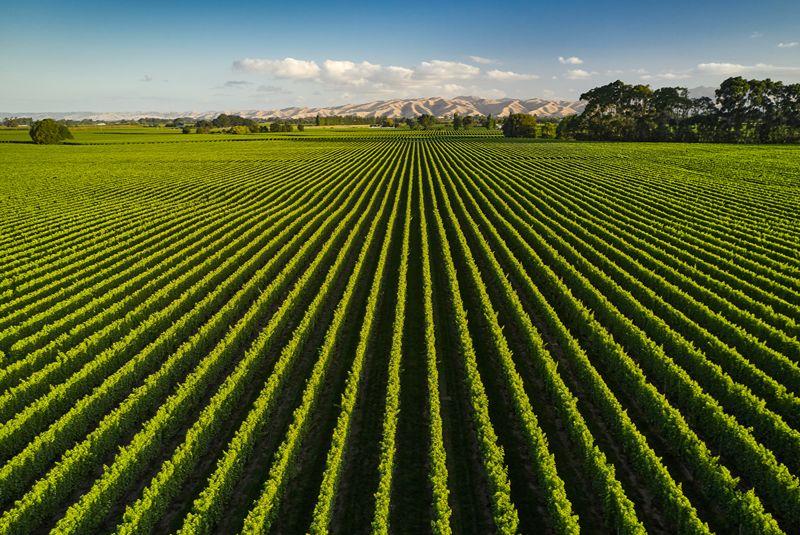
The 2025 New Zealand wine harvest has been widely welcomed following 2024’s reduced yields. Across the regions, winemakers reported not only a normalisation of volumes but also excellent fruit quality – notable in a country where diverse geography often leads to variability.
A warm, dry spring set the season up well, though a cooler, wetter December and January period tested nerves before settling into a classic Indian summer. While perhaps not as straightforward as the outstanding 2024 vintage, 2025 looks set to produce wines of finesse and charm across the regions and varieties, with the first releases just months away.
Auckland
Michael Brajkovich MW of Kumeu River expressed relief at a ‘normal’ sized vintage after two seasons down by 35-40%. Auckland experienced the driest summer since 1958, with consistent warmth but no heat spikes.
‘The fruit ripened evenly and with gradual aroma and flavour development,’ Brajkovich said. Chardonnay was once again the star, arriving early and in pristine condition.
Gisborne
Described as a ‘magnificent vintage’ by Kirsten Searle of Matawhero, 2025 brought full physiological ripeness and a return to normal yields after two lighter years. Chardonnay excelled, providing excellent fruit for both table wines and sparkling bases.
Searle also highlighted the Gewürztraminer from Matawhero’s Riverpoint vineyard as particularly impressive – a fitting celebration for the winery’s 50th anniversary.
Hawke’s Bay
There is genuine excitement in Hawke’s Bay, with some suggesting that 2025 may rival the renowned 2013 vintage. Ben Tombs noted Craggy Range’s earliest-ever harvest, with Chardonnay off the Gimblett Gravels picked on 8 February.
Whites show ‘electric flavour profiles with moderate alcohol’ while Syrah, despite late-summer humidity challenges, enjoyed extended hang time without excessive sugar accumulation, promising finely structured, vibrant reds.
Wairarapa
After four small vintages, Martinborough celebrated a strong yield. A relatively calm spring and lighter winds led to strong shoot growth and abundant flowering. Intensive canopy management paid off with Pinot Noir showing a savoury, charming profile.
Tombs commented on lower acidity and softer tannins compared to the more firmly structured recent vintages at Craggy Range’s Te Muna vineyard.
Nelson
Todd Stevens of Neudorf reflected positively on the vintage: ‘It’s still early but the whites appear beautifully balanced, while the Pinots show poise and should present very well.’ Initial signs point to good consistency across this smaller but significant region.
Marlborough
Murray Cook of Dog Point summed up 2025 as ‘a season of patience’. ‘With generous yields, the fruit took some time to ripen fully. Thankfully, we were blessed with classic dry and warm conditions which kept fruit quality high over what was our longest harvest period (46 days) in 24 years,’ he added.
However, with global inventories still high amid flat consumption and geopolitical uncertainties, many producers opted to leave fruit on the vines. The upside: only the best fruit was picked and consumers can look forward to excellent quality from this key region.
North Canterbury
A rollercoaster year, with Greystone’s Dom Maxwell describing it as one that ‘challenged us, then offered a lot, then challenged us again, and finally delivered in the end’.
Pure fruit flavours and clean fermentations made it a worthwhile ride. ‘We’re excited about the quality we have in the winery,’ Maxwell added.
Central Otago / Waitaki
Valli’s Jen Parr described an unusually compressed harvest of around half the usual span. Despite spring frosts affecting yields, she was thrilled with the ‘tremendous concentration’ and ‘crazy colour’, particularly in Gibbston and Bendigo.
Small berries and clean fruit were common themes with Parr commenting that wines possess richness and an appealing ‘joyful’ quality that should drink well young but also reward a few years in bottle.
The Waitaki Valley – often marginal – had one of its best vintages in recent years, for both ripeness and volume.
View the extended list of The World’s 50 Best (actually 51st to 100th) Vineyards.
The list of The World’s 50 Best Vineyards 2025 will be revealed at a live awards ceremony in Margaret River, Western Australia, on 19 November.
From established names to rising stars, find out more about the storied estates ranked 51st to 100th in the global ranking, each of which dazzles with world-class terroir, immersive visitor experiences, and unforgettable hospitality.
The 51-100 New Zealand wineries in this prestigious list include:
No.100 Ata Rangi, Martinborough
Ata Rangi in Martinborough is a boutique, organic estate that has earned New Zealand Grand Cru status. It was founded by a dairy farmer who successfully turned his hand to grape growing (with the help of his wife and sister), hence its name, which translates to ‘new beginnings.’
No.100 Ata Rangi, Martinborough
No.98 Felton Road, Central Otago
Felton Road is a pioneer of natural wine and an artisan producer of pinot noir, chardonnay and riesling vintages in New Zealand’s Central Otago region. Surrounded by snow-capped mountains, African Boer goats roam the rugged landscape of these organic and biodynamic vineyards.
No.98 Felton Road, Central Otago
No.90 Kumeu River Wines, Auckland
Kumeu River Wines in Auckland features wines made by New Zealand’s first-ever Master of Wine, Michael Brajkovich. Covering 30 hectares of heavy clay soil over sandstone, the vineyard is known for producing world-class chardonnay.
No.90 Kumeu River Wines, Auckland
No.89 Greystone Winery, Waipara
Greystone Winery in Waipara, on New Zealand’s South Island, is an organic, regenerative wine estate that offers guests off-grid accommodation in a glass eco-cabin overlooking the vineyard.
No.89 Greystone Winery, Waipara
No.52 Wairau River Wines, Marlborough
Wairau River Wines was founded by viticulturalist Hamish Rose and his brother and winemaker, Sam Rose. This idyllic New Zealand vineyard is renowned for crafting award-winning sauvignon blanc.
Some of your committee attended, by invitation, a Wine Fair at The Wellington Club on Tuesday 24th June. The evening showcased the rich diversity of NZ’s wines and their distinctive winemakers from boutique producers across the country. And introduced most of us to a number of the smaller vineyards from Central to Matakana.
If you would like to Google some of the vineyards or hear more about them, these were the vineyards at the evening:
Schubert, Martinborough- est. in 1998
Hans Herzog, Blenheim – planted in 1996
Te Motu, Waiheke Island – est. in 1999 – the oldest family-owned vineyard on the island
Puriri Hills, Auckland – set up in 1996 – they make red wines in the French style
Rock Ferry, Blenheim – set up in 2005 – organic new world wines [10 varieties]
Valli, Central Otago – est. in 1993
Dragon Bones, Waitaki Valley, North Otago off-grid – est. 2005
Organised Chaos, Clive, Hawkes Bay
Mon Cheval, Waipara
Zenkuro Sake, Central – est. 2015 – rice and yeast are imported from Japan, they want to change the public perception of how to drink this
Corofin, Blenheim
Gillman, Matakana – est. 1998 – they make unapologetically only red wines
Julz – Collaboration Wines, Hawkes Bay – est. 2010
The evening was an interesting sampling from some great vineyards, with above average priced wines that were discounted for the evening. It was nice to be able to talk with the growers/wine makers about how they produce the product and about their differing views on terroir etc.
Reminder: At the August Monthly Meeting, for the first 10 minutes, we will hold an SGM to discuss and pass some small changes to the Club’s Constitution. Please ensure you are up to date with the contents of an earlier email sent on 21 July in relation to these changes.
Evening support
It was great to have everyone help with the tables and chairs at previous meetings and take the same down at the end. Also, take the spittoons/water jugs/cracker plates back to the kitchen. Could we please continue this new routine?
PLEASE NOTE: We can’t arrive to do the setting up activities any earlier than 7:30 pm as we interrupt the cleaner(s) schedule; the cleaners are in the hall until 7:30 pm.
Under new ownership, Villa Maria captures a global market
When Matthew Deller decided it was time to bring his family home from Napa Valley in California, there was only one place he wanted to work: Villa Maria.
He made his move in January 2020 after seven years as chief operating officer at Tor Wines – a winery globally renowned for its single-vineyard chardonnay and cabernet sauvignon.
And so, after a roller-coaster journey of sorts, he’s perfectly placed to oversee the first global launch of Villa Maria’s single-vineyard series of wines from tomorrow.
Deller, a master of wine, is Villa Maria’s chief global sales and marketing officer. In his almost two years with the brand, he’s experienced the rapid change brought by Covid-19 as well as seeing Villa Maria pass out of family ownership.
Villa Maria Estate Winery’s Blenheim acreage. Image: Brya Ingram/Stuff/Marlborough Express
Villa Maria’s parent company FFWL, owned by founder Sir George Fistonich, went into receivership late in 2020 and as part of that, Villa Maria was sold to Indevin, New Zealand’s largest wine-making company, in September.
“When we decided we wanted to move back to New Zealand and I was thinking ‘who would I want to work for?’ Deller says. “Villa Maria was the only option. There’s no other winery in New Zealand that makes the calibre of wines that Villa Maria does and that’s not going to change in under the new ownership.
“We’ve all been on a roller-coaster over the past 18 months. But the management at Villa Maria wasn’t exposed too much to that financial side as that was between the family and the banks.
“Indevin is very protective of the brand and what drove its success: it’s all about quality and global critical acclaim. And that’s not my opinion, that comes to us from our wine intelligence research.”
Other significant changes include the way Villa Maria is marketed.
“We’ve renovated every brand,” Deller said. “We’ve brought out Earth Garden range this year which is our first 100 per cent Biogrow-certified brand and fully vegan. And we’ve really ramped our global fine wine programme.”
As part of that global push, this year marks the first time that Villa Maria is doing a worldwide launch of its single vineyard series. That will involve events around the world throughout November. “We’re there in New York, London, Europe and there’ll be dinners, wine-maker tastings with a unified release of these single-vineyard wines.”
Indevin had been on the lookout for a quality New Zealand global brand for some time, says chief executive Duncan McFarlane.
Single vineyard releases are a winery’s way of showing what a particular block of land delivers. The 10 wines Villa Maria are releasing come in tiny volumes – just hundreds of cases for some styles. The grapes are mostly handpicked and many are fermented with wild yeasts.
The idea is to create a series of bespoke wines that Deller says are chosen for their elegance and as “the greatest expression of a particular vineyard”.
The release features vineyards in Auckland (Ihumātao), Gisborne (McDiarmid Hill) Hawke’s Bay (Braided Gravels, Keltern) and Marlborough (Attorney, Taylors Pass, Seaspray, Seddon, Southern Clays).
Deller said it was the right time to make a global push as New Zealand wine – particularly Marlborough sauvignon blanc – was at a “tipping point” in terms of appreciation by critics and collectors.
“Now that New Zealand wines are getting really high scores from international critics, all of a sudden they’re of tremendous interest to the fine wine community, British wine merchants and top New York restaurants. The market has been created by those global critic scores.”
And that maturation of the industry, in terms of quality, has dove-tailed with Covid-19 to create a perfect storm of desire for New Zealand-made wines.
“What happened last year was a huge shift in awareness of, and demand for, New Zealand wine and Brand New Zealand was on fire last year. The insights I have from the US is that a significant part of that is our sustainability story.
“What’s happened this year is another seismic shift – and perhaps one that’s more exciting and of more significance for New Zealanders. We had a small harvest in 2021 but it’s high quality. And with that, we’ve reached a tipping point where New Zealand wines are now recognised as really good. They’ve always been regarded as good but now they moved to really good.”
The Villa Maria Keltern chardonnay.
He noted that one of the world’s leading wine commentators, Jancis Robinson, wrote a glowing report on New Zealand wine, focusing on sauvignon blanc and pinot noir which helped push Marlborough sauvignon blanc from a supermarket staple to standing proudly alongside the best France could offer.
“Marlborough sauvignon blanc had already surpassed France in terms of mass awareness but the more conservative critics have always considered the fine wines of Sancerre as superior to Marlborough sauvignon blanc but that seems to have changed and Marlborough sauvignon blanc is now a fine wine benchmark as well as a reliable benchmark.”
The other thing that’s happened is that a number of factors – including increased costs of packaging and shipping – drove up the price of New Zealand wine and no one blinked. In fact, demand increased.
Deller says not only are people in love with the flavours of New Zealand wine but they are “buying an experience they can’t get from anywhere else” and part of that is a story of sustainability, ethical employers, and a focus on quality.
For Villa Maria, a critical part of that story is staying New Zealand owned. When the receivers came in at FFWL they needed to find over $200m to pay back bank loans. Selling Villa Maria was critical to raising that money and there was a fear an iconic Kiwi brand could end up offshore.
But it stayed in New Zealand thanks to Indevin, a giant wine-maker that most people have never heard of.
Indevin’s model is to grow grapes and make wine. It leaves the sales and marketing to third parties including brewing giant Lion – for whom Indevin produces the Lindauer range, among others – as well as Waitrose and Tesco supermarkets in the UK.
Chief executive Duncan McFarlane says Indevin had been on the lookout for a quality New Zealand global brand for some time.
“Rather than Indevin doing the brand building and holding the sales expertise in-house we’ll partner with someone who has that, and we’ll focus on the parts of the supply chain where we have the expertise and can create value,” he explains.
“But that meant there was a significant part of the New Zealand category that we weren’t participating in – that wasn’t a problem as such as we’d been successful with our model – but we believed that as the New Zealand wine industry matured, with the right brand, the right proposition, there was a lot of additional value to be created.
“Our long-term strategy has been if the right opportunity came along to acquire a genuine global New Zealand brand then that would be a very interesting, exciting and rewarding acquisition.
“Identifying that and actually having the opportunity are two different things.”
McFarlane couldn’t have hoped for a better opportunity than the unexpected sale of Villa Maria after 60 years of family ownership. “We felt that not only was it an amazing opportunity it was an unparalleled opportunity.”
McFarlane says Indevin and Villa Maria will continue to walk their own paths when it comes to sales and marketing, with Indevin remaining a business-to-business model and Villa Maria being a business-to-consumer operation.
But behind the scenes, on the production side, there is huge room for efficiency and growth.
“In many cases, the two businesses literally have vineyards next to each other or in the same street – so it makes sense that the production side of the business will come together over time to work as a team.”
Villa Maria single-vineyard Taylors Pass sauvignon blanc and pinot noir, part of a range of 10 it’s releasing globally.
Adding Villa Maria’s vineyards and expertise to Indevin’s means a diversity of supply that “de-risks” the business on one hand while “putting you in a strong position to maintain and provide consistent quality season-to-season”.
As the ultimate boss, McFarlane has no qualms about Villa Maria hosting a series of global launches during a global pandemic.
“Like any business, we’re conscious of Covid, and management of risk is at the forefront of how we do things, but at the same time there are growth opportunities overseas and where we can do it, and do it safely, it’s business as usual.”
As for his pick of the single-vineyard wines, the chardonnay lover says he’s “quite honestly staggered” by the Keltern Chardonnay from Hawke’s Bay.
Sidebar; The Villa Maria Single Vineyards
Auckland – Ihumātao
Located on Auckland’s Manukau Harbour, Ihumātao sits within a shallow, sheltered volcanic crater with a soil profile that is diverse with a calcified shell and ancient scoria on the edge of the basin, with heavier peat and clay soils toward the centre layered above a volcanic basalt rock base. The immediate proximity to the Manukau Harbour provides a cooling influence, favourable in the retention of fruit acidity during the ripening season.
Gisborne – McDiarmid Hill
Home to expansive fertile plains framed by forested hills on one side and 200km of coastline on the other, the province has an abundance of natural resources. Gisborne’s climate is characterised by warm summers and mild winters. McDiarmid Hill is positioned on an elevated north-facing hillside slope in Patutahi. Taking full advantage of sunlight, drying wind conditions, slightly cooler temperatures and natural water drainage, the additional elevation provides a wonderful advantage for producing this consistently outstanding wine.
Hawkes Bay Braided Gravels | Keltern
The Gimblett Gravels Wine Growing District is characterized by arid, stony gravels laid down over millennia then exposed by a huge flood in 1876 that altered the course of the Ngaruroro River. East of the Maraekakaho region, Keltern is a warm inland site, buffered by the Ngaruroro River. Established on an ancient riverbed that is very dry, but not as hot as the Gimblett Gravels.
Marlborough is surrounded by the inland Kaikoura Ranges to the south and the Richmond Ranges to the north. These rugged mountains are responsible for New Zealand’s driest and sunniest climate with an average of 2435 hours of sunshine, regulated by the cooling ocean influence, elongating the ripening period. Marlborough is composed of three sub-regions, each with its own distinctive characteristics and nuances, which are experienced in every taste.


 Emma Jenkins MW Decanter | 2 May, 2025