The value of wine exports has dropped slightly over the past year, though volumes remain strong with an exceptionally large 2025 harvest to drive growth.
NZ Winegrowers annual report indicates exports rose 5 percent by volume in the year ended June, though the value of exports was down slightly at $2.10 billion.
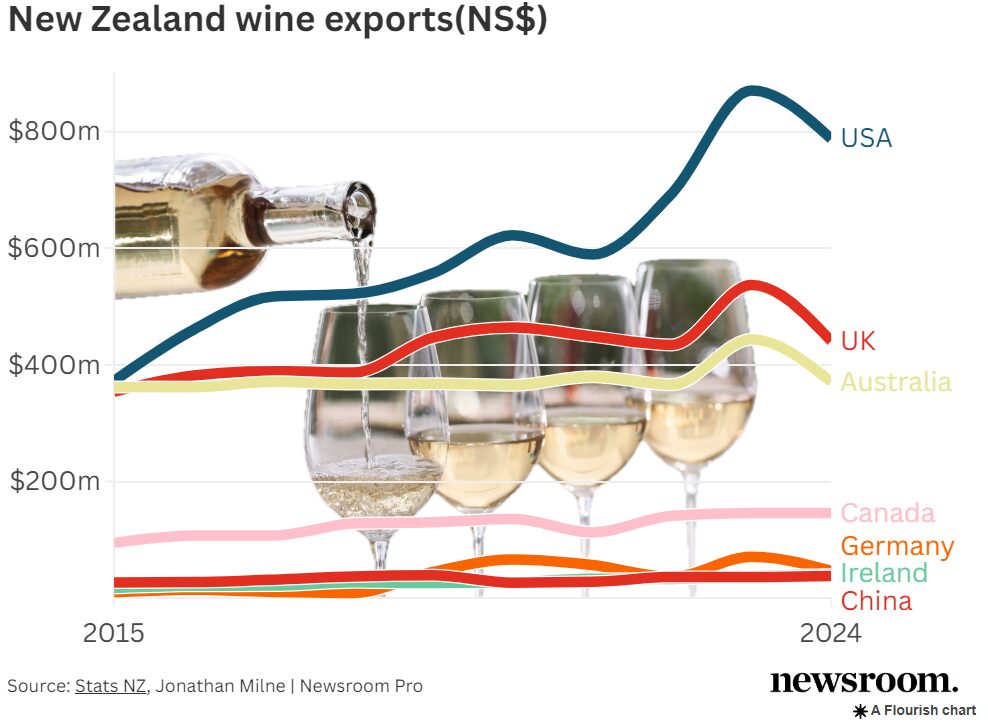
Association chair Fabian Yukich said there had been strong export growth to Asian markets over the past year, though the value of exports to the major United States market fell 4 percent to $762 million.
About 90 percent of the wine produced in New Zealand was exported to more than 100 countries.
Shipments to China grew 47 percent to $56m, while exports to South Korea lifted 92 percent to $44m.
Overall exports to second-tier markets, which excluded UK, USA and Australia which together accounted for 70 percent of exports, rose 17 percent in the past 12 months to just under $600m.
“According to market researcher IWSR, lighter refreshing styles are outpacing overall wine category performance,” Yukich said.
“This shift is driven by varietals with more refreshing palate profiles, which New Zealand excels in delivering.”
However, he said the industry was facing a number of challenges, with uncertainty around the long-term impact of tariffs on demand for New Zealand wine in the United States.
“While the increased tariffs have been in place since April, with a further increase in August, it is not yet possible to discern the effect of these in the export data.”
Vintage 2025
The 2025 vintage was unusually large with positive weather conditions bringing warm, dry days and cool nights, producing a high-quality harvest, though a lot of grapes were left on the vine.
Winegrowers chief executive Phillip Gregan said the grape yield was exceptional with the volume far exceeding the industry’s ability to process.
“The weather was so fantastic for grape growing that crop was really once in a generation,” Gregan said.
“There was no way we were ever going to be able to harvest all those grapes. We wouldn’t have had the capacity in our wineries. So there’s still plenty of our wine available to grow sales over the last.”
The signing of the UK-NZ trade deal was ‘just the start of the journey’, official says after update to reduce wine barriers
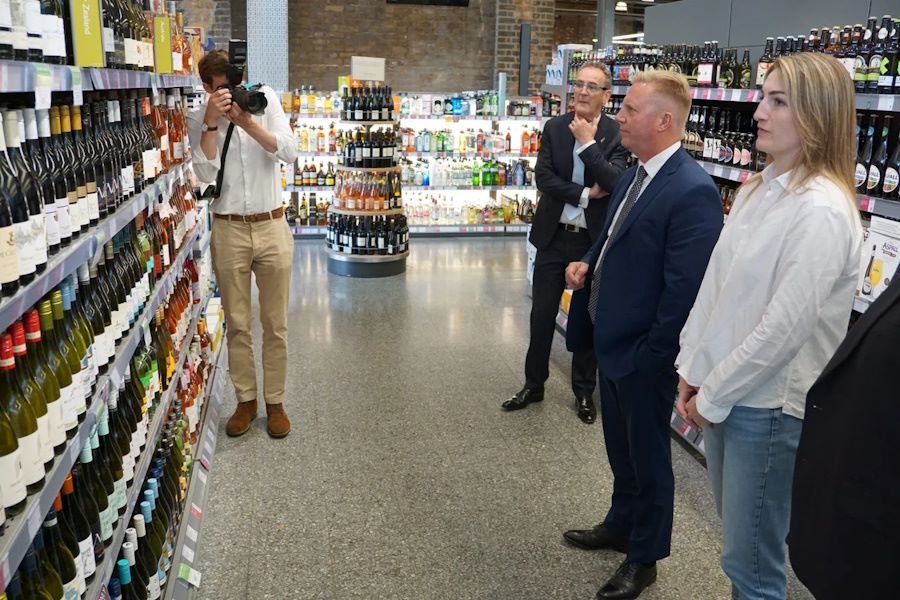
Trade and Investment Minister Todd McClay examines New Zealand wines on sale in a London supermarket. Photo: Supplied
New Zealand wines now have a smoother pathway into the United Kingdom, with one British official saying the changes show the value of the “living, growing” trade deal between the two countries.
Government officials and ministers from both countries met in London last month for the joint UK-NZ ministerial trade committee set up to monitor the free trade agreement signed in 2022.
Following the committee meeting, the UK formally agreed to accept exports of New Zealand wine made using ammonium chloride, agar, alginic acid, and potassium ferrocyanide (used to adjust the stability, clarity and acidity of wine).
Frazer MacDiarmid, the British High Commission’s lead trade policy adviser, told Newsroom the winemaking changes were a good example of the trade deal’s status as a “living, growing agreement”.
“The perception is that once you’ve signed, that the deal’s done, you never even think about it again … but certainly from the UK perspective, and I think it’s shared by the New Zealand government, that’s actually just the start of the journey.”
MacDiarmid said the annual committee discussions were a chance to assess the success of the deal, reflect on feedback from businesses, and think about what changes could be made in response.
The deal had been largely well received in the UK, with concerns from some about New Zealand lamb imports flooding the market not borne out by trade statistics.
After formally leaving the EU in early 2020, the UK had needed to quickly get a handle on trade policy and negotiations, and had looked to New Zealand as a “key partner for how trade is done”, MacDiarmid said.
“It’s been quite a collaborative relationship with New Zealand, to the level of exchanging notes about how different negotiations are going, and different negotiation tactics for different FTAs that we’re hoping to get with other partners.”
NZ Winegrowers general manager for advocacy Sarah Wilson told Newsroom closer regulatory alignment between the two countries was good news for winemakers sending their product to their second-largest export market.
Wilson said the original trade deal had also allowed for greater flexibility on labelling and other winemaking practices for New Zealand wine headed to the UK.
The sector would also support the UK joining the World Wine Trade Group, a government-industry partnership set up to remove trade barriers, as that would lead to “full mutual acceptance” of winemaking practices between the two countries.
Trade and Investment Minister Todd McClay told Newsroom the UK’s decision was a good example of how high-quality trade deals could deliver value beyond tariff reductions.
“This is exactly what the NZ-UK free trade agreement was meant to do – remove trade barriers, support regulatory alignment, and make it easier for exporters to get their products to market.”
Wine exports to the UK were worth $426 million this year, and McClay said aligning winemaking standards would give local producers greater flexibility to use modern techniques while maintaining market access and growing trade.
“The UK’s move shows confidence in New Zealand’s production systems and highlights the kind of trust-based, practical trade relationships we’re focused on – ones that deliver real outcomes for exporters.”
British High Commissioner Iona Thomas told Newsroom the changes showed the trade deal wasn’t “just a one-off piece of paper” but an ongoing, active partnership between the two countries.
“The annual joint committee, and the work that our policy teams do week in, week out, is where we turn the ambition of the agreement into action,” Thomas said.
“The work that goes on behind the headlines ensures the deal delivers real benefits for businesses, consumers and communities on both sides of the world.”
New Russian law orders French producers to label their champagne ‘sparkling wine’. Photo / Getty Images
Russian oligarchs are facing a shortage of champagne after French producers temporarily cut off supplies to the country over a new law that will force them to label their drinks as “sparkling wine”.
Last week, President Vladimir Putin signed off on legislation stating that only wine produced in Russia could be labelled as “champagne”, while foreign makers would have to rebrand their bubbly.
Neither the President nor Parliament explained why Russia needed such a law.
The “champagne” controlled designation of origin is governed by very strict rules in France, which state that the wine must originate from a small area in the Champagne region, be made with approved grape varieties and mature for a minimum of 15 months.
Moet Hennessy, which produces drinks such as Moet & Chandon, Dom Perignon and Veuve Clicquot, told partners in Russia that it would have to halt distribution.
In a letter to local businesses, Moet Hennesy, part of the French luxury goods group LVMH, said stocks of its champagnes would therefore be at an “extremely low level”, exacerbated by a wider drop in imports over 2021.
Later, the company told Bloomberg that it would add a “sparkling wine” mention on the back label of their bottles, and resume deliveries once these changes were made.
Olga Sokolova, a sales director at Vinicom, which imports and distributes foreign wine in Russia, denounced the situation as absurd as she shared the letter from Moët Hennessy on social media.
“This seems like it’s fake, but it’s true,” she said. “From today, black is now white, and white is black.”
Others online were equally damning of the change in the law, with the exiled oligarch and Kremlin opponent Mikhail Khodorkovsky saying he thought “the whole champagne thing was a joke”.
Vineyards in the Champagne region of eastern France. Photo / AP
Sergei Mironov, a restaurant owner, quipped that Moscow’s next step would be to ban Scots from using the word “whisky”.
Other experts questioned whether Russia had the legal jurisdiction to force foreign products to rebrand.
Vadim Drobiz, director of the Centre for the Study of Federal and Regional Alcohol Markets, told the business newspaper RBK that about half of the 330 million litres of still and sparkling wine imported to Russia every year could be affected.
The new law came as Putin signed a decree stating that the “Westernisation” of Russian culture was one of the primary security threats to the country.
Moscow banned the import of Western cheeses, meats and other food products in 2014, as a response to European and US sanctions over the annexation of Crimea.
The ban motivated local producers to develop their own versions of European goods, such as “Russian parmesan”.
Russian President Vladimir Putin signed a decree stating that the “Westernisation” of Russian culture is one of the primary security threats to the country. Photo / AP
In the 1920s the USSR created a cheaply produced “Soviet Champagne” as a way of bringing luxury goods to the masses.
In recent years, a growing number of wine-makers have launched in southern Russia.
French media has dubbed the import spat the “champagne war” or the “bubble war”.
Champagne producers have long been extremely protective over their brands. Last week, French wine producers won a legal battle to prevent an ice cream from being called “champagne-flavoured”, according to a German court, after a long battle against the supermarket giant Aldi.
New Zealand’s wine industry built its name on sav, but we’ve been putting all our eggs in one basket for too long, writes Jules van Costello.
Savvy represents 63% of New Zealand’s area under vine, 74% of our wine production and a whopping 88% of our exports by volume, meaning for every dozen bottles of wine we export, over 10 of those are sauvignon blanc. Photo: Getty Images
I like to think of sauvignon blanc as the IPA of wine. It’s brash, bombastic and a little bit basic (in a good way). Like IPA, its tropical aromas of guava, passionfruit, lemongrass and a little bit of sweat jump forth from the glass. In the words of wine educator Oz Clark: “There had never before been a wine that crackled and spat its flavours at you from the glass”. It should not be surprising that some of the flavours in savvies and IPAs are the same – New Zealand’s most acclaimed hop variety, Nelson Sauvin, is named for its olfactory similarity to Marlborough sauvignon blanc.
Savvy is easy to understand and even easier to like. In the world of wine, which has a tendency to disempower consumers by letting so-called “experts” hoard knowledge, this is unequivocally a good thing.
Sauvignon blanc put New Zealand on the map. It is the foundation on which the entire export side of our wine industry has been built. But sadly, there can be too much of a good thing. While writing my new book, Beyond the Vines: The Changing Landscape of New Zealand Wine, I’ve had to wrestle with the fact that while sauvignon blanc is amazing, the New Zealand wine industry has too many eggs in one basket. It represents 63% of New Zealand’s area under vine, 74% of our wine production and a whopping 88% of our exports by volume, meaning for every dozen bottles of wine we export, over 10 of those are sauvignon blanc.
In August 2020, New Zealand Winegrowers released their annual report which stated that, despite six months of Covid-19 affecting sales, we’d actually exported more wine than ever before. Big grocery brands have done incredibly well but many smaller producers are feeling the pinch. The smaller the producer, the more likely they are to be selling wine in restaurants, which is hard when restaurants are shut or diners are too scared to go out. Secondary lockdowns in Melbourne, London and even in Auckland, as well as the huge mishandling of Covid in our biggest markets – the USA and UK – have had profoundly negative effects for many Kiwi producers.
New Zealand, the forward-thinking upstart that it is, committed to free trade in the mid-1980s. We are an export economy and from my position, this has generally helped us do business. However, one of the consequences of this is that no industry is too big to fail. Our producers, unlike those in Europe, for instance, cannot rely on government intervention to keep them afloat if the arse drops out of the market.
Ripening white grapes at a vineyard in Marlborough Region, country’s largest winegrowing region with distinctive soils and climatic conditions, South Island of New Zealand. Photo: Getty Images
Sauvignon blanc is popular now across the globe, but what happens when the bubble bursts? We could face a quick trend shift à la Sideways that saw merlot’s demise, or even a sudden global event change how the wine world works overnight. Most of the players who are making big bucks on industrial sauvignon blanc will not care. They will move onto something else. The growers and the wineries will be hurting. The wine world is a slow-moving beast, but it is also a fickle one. At this stage, New Zealand does not have an exit strategy.
Savvy is important – we can make relatively high-quality juice relatively cheaply. This is what got us into this problem in the first place. But we can also make world-class wine all over New Zealand. We need to champion more serious styles of sauvignon blanc, which we excel at.
We also need to diversify, and quickly. Despite having over 55 commercial varieties being grown, land devoted to most varieties has been dwindling (all but sauvignon blanc, of course, pinot noir, pinot gris and syrah).
I myself am heavily invested in the natural and lo-fi wine game with my businesses Cult Wine and Te Aro Wine but, strangely enough, I do not think this is the saviour of the industry, nor is making more and more serious wine. We need to find something we can make relatively cheaply, well, and for which there is an international demand.
I believe light red wines are part of the answer to the problem of the sav bubble – Montepulciano from Italy, St Lauren from Austria and Gamay are all contenders. In Australia, these light reds have taken off domestically and are making waves internationally. Like sav, we can make affordable pinot relatively well so there is no reason why we cannot apply these skills to grape varieties that are a little easier to grow. I happen to like drinking light reds but this is one solution that should also suit consumers in Australia, USA and the growing Chinese market.
We also need to experiment, throw grapes at the wall to see what sticks. The bubble will pop. We need to be ready.
International demand for New Zealand wine shows no sign of slowing, with total export value reaching a record $1.83 billion according to the 2019 Annual Report of New Zealand Winegrowers.
Export value has risen by 6% in June year-end 2019, and at a retail level, this translates to over $7 billion dollars of New Zealand wine sold around the world annually. The UK and USA led the growth, with the USA continuing to be New Zealand wine’s largest market with over $550 million in exports.
The premium reputation of New Zealand wine has translated to real value in its major markets where the country remains either the highest or second-highest priced wine category in the USA, UK, Canada, and China. “This year’s export results again reflect the New Zealand wine industry’s strengths, and reinforce our international reputation for premium, diverse and sustainable wines.” said John Clarke, Chair of New Zealand Winegrowers.
The report highlights the completion of the 2018 PwC Strategic Review, the first within the industry since 2011, which provided a wealth of usable insights into the state of the New Zealand wine sector, challenges and opportunities. “The Strategic Review report noted the continued steady growth of the industry, and identified a range of challenges and risks that need to be addressed to maintain that trajectory and ensure all members have the opportunity to benefit” said Mr Clarke.
Mr Clarke noted the Strategic Review underscored how important all aspects of sustainability were in order to maintain the New Zealand wine industry’s social license to operate. “As an industry, we need to ensure our key focus is on enhancing sustainability initiatives. Sustainability is a cornerstone of the reputation of New Zealand wine, and is vital to the ongoing success of our industry.”
Highlights over the last year include the completion of the first phase of the Bragato Research Institute’s climate change programme, the commencement of a new research winery facility, and the International Sauvignon Blanc Celebration, which saw over 100 international wine producers, experts and key influencers visit Marlborough to experience New Zealand’s diverse Sauvignon Blanc offerings.
The 2019 Annual Report can be accessed here.
For further information contact: Philip Gregan
CEO, New Zealand Winegrowers
021964564
Editor’s note:
• Wine is New Zealand’s sixth-largest export good.
• New Zealand wine is exported to more than 100 countries.
Waimea Estates is one of Nelson’s larger producers with over 140 hectares of their own vineyards. The cool climate and alluvial soils of Nelson’s Waimea plains combined with the highest sunshine hours in New Zealand allow vibrant, fruit-focused wines to be made.
Waimea’s export varieties are based on highly awarded Sauvignon Blanc, Pinot Gris and Pinot Noir, and over the years Waimea has gathered 150+ Gold Medals and 26 Trophies across nine different wine styles – proving the versatility Waimea and the Nelson region provides. More next month.
A warm summer benefited New Zealand’s winegrowing regions, with 419,000 tonnes of grapes harvested during Vintage 2018.
This is up 6% on the 2017 tonnage but is still lower than initially anticipated in a season marked by a very early start to harvesting.
New Zealand Winegrowers CEO Philip Gregan says many wineries had been hoping for an even larger vintage, given 2017’s small harvest.
“However, we now expect export growth in the year ahead will be modest. It will be up to wineries to manage any product shortages from the vintage.”
In addition to prompting an early harvest, the warm summer produced fruit with good ripeness levels.
A highlight from Vintage 2018 is the increased production of red wines.
“Production of both Pinot Noir and Merlot has lifted more than 20% on last year, which will be welcomed by both wineries and consumers. These varieties were down sharply in 2017 and it is very positive to see a return to more normal production levels this year,” Mr Gregan says.
New Zealand Winegrowers is confident Vintage 2018 wines will add to New Zealand’s reputation as a premium producer of cool climate wines.
“Every vintage is different and ultimately the final test is the quality delivered in the bottle to consumers. We are certain that consumers will enjoy the benefits of the warm summer when they get to taste the wines from Vintage 2018,” Mr Gregan says.
New Zealand wine exports are currently valued at $1.71 billion, up 3% in the past year. Wine is New Zealand’s fifth largest export good.
For further information contact:
Philip Gregan Chief Executive Officer New Zealand Winegrowers 021 964564
The beer and wine aisle of a 365 by Whole Foods Market grocery store is pictured ahead of its opening day in Los Angeles. New Zealand sauvignon blanc has found a ready market in the US.
New Zealand’s wine export values continue to rise thanks to strong United States demand, reaching $1.66 billion for the year, up 6 per cent on the year before.
While the percentage increase is lower than the average yearly growth of 17 per cent for the last 20 years, the industry was still on track to reach $2b worth of exports by 2020, chairman of New Zealand Winegrowers Steve Green said.
The latest NZ Winegrowers annual report shows to the end of June this year, the US market is worth $517 million, up 12 per cent. New Zealand wine became the third most valuable wine import into the US, behind only France and Italy.
NZ wine, a 2017 snapshot.
Green forecast next year’s export volumes would be “more muted” because of the smaller harvest of 396,000 tonnes, down 9 per cent on 2016, but wineries were confident quality would remain high.
While the US provided the best returns, more litres of wine (74 million) were exported to the United Kingdom for a much smaller return of $389m. Traditionally more bulk wine has been sent into the UK market. Behind the US and the UK came Australia, Canada, the Netherlands and China.
Former US ambassador to New Zealand Mark Gilbert, along with many of his countrymen, has a nose for a good wine. He attended a tasting of New Zealand and French pinot noir last year.
The most exported variety was sauvignon blanc, followed by pinot noir and chardonnay.
The recently passed Geographical Indications (Wine and Spirits) Registration Act would offer improved protection of New Zealand’s regional identities. The industry had also launched the sustainable winegrowing New Zealand continuous improvement extension programme to enhance the reputation of wines.
Of a total growing area of 37,129 hectares, sauvignon dominates at 22,085 ha, an increase of 685 ha from the year before. The second most popular variety was pinot noir, with 5653 ha, followed by chardonnay at 3203 ha and pinot gris (2469 ha).
Marlborough is overwhelmingly the largest region with 25,135 ha planted in vines, followed by Hawke’s Bay (4694 ha), Central Otago (1896 ha) and Canterbury/Waipara (1425 ha).
The number of wineries was 677; they reached a peak of 703 in 2012.
New Zealanders drank 40 million litres of imported wine during the past year, most of it Australian (29m litres), with the next two most popular French and Chilean.
The November Kaikoura earthquake damaged an estimated 20 per cent of Marlborough’s tank capacity, but by harvest time all of the lost capacity had been restored or replaced.
Green said the industry consulted with members on possible changes to export tasting requirements, with responses suggesting a rethink of export requirements was needed.
“We continue to believe more needs to be done in our export legislation to ensure that the same standards apply to every bottle of New Zealand wine, no matter where it is bottled,” Green said.
NZ Winegrowers were concerned at the Ministry for Primary Industries’ plan to take part of New Zealand Winegrowers’ wine export certification service contract in-house.
“We fought hard to retain the status quo, which has served our members well, and are disappointed with the level of industry consultation in MPI’s decision making process. If the service changes, we will be seeking guarantees from the government that the current speedy issuance of export eligibility statements will be protected, at no additional cost to members,” Green said.
In June the New Zealand Grape Growers Council and the Wine Institute of New Zealand finished as entities, replaced by a unified New Zealand Winegrowers.
New Zealand is now the only major wine producing nation with a single industry body, representing and advocating for the interests of its entire grape and wine industry.
The industry and the Government are working through a Primary Growth Partnership on research into lighter wine production and marketing. Last year retail sales reached $33.5m. The programme runs through to 2021, by which time $16.97m would have been spent on the partnership.
Organic wine production continues to flourish with more than 60 New Zealand wineries now making fully certified organic wines, and more still in the organic conversion process.
Wednesday, 3 May 2017, 2:34 pm | Press Release: New Zealand Winegrowers
Leaves & vines from Kirkpatrick Estate Winery
Wine exports to the USA surpass $500 million for the first time
The latest data from Statistics New Zealand show wine exports to the USA have surpassed $500 million for the first time, up 11% in the last year.
As the wine industry advances towards its goal of $2 billion of exports in 2020, there is significant potential for further growth in North America said Philip Gregan, CEO of New Zealand Winegrowers.
“New Zealand wine, especially Sauvignon Blanc, is very popular in the US and we expect consumer demand to continue to grow.”
“The new record level of wine exports into the world’s largest and most competitive market is an outstanding achievement for New Zealand wine exporters and testifies to the strong global demand for our wines.”
New Zealand wine exports reached a new record of $1.63 billion in March year end 2017. Wine is now New Zealand’s fifth largest export good by value.
The announcement of the new export records come at a busy time for the wine sector with the 2017 vintage nearing completion and the advent of International Sauvignon Blanc Day celebrations on Friday 5 May.


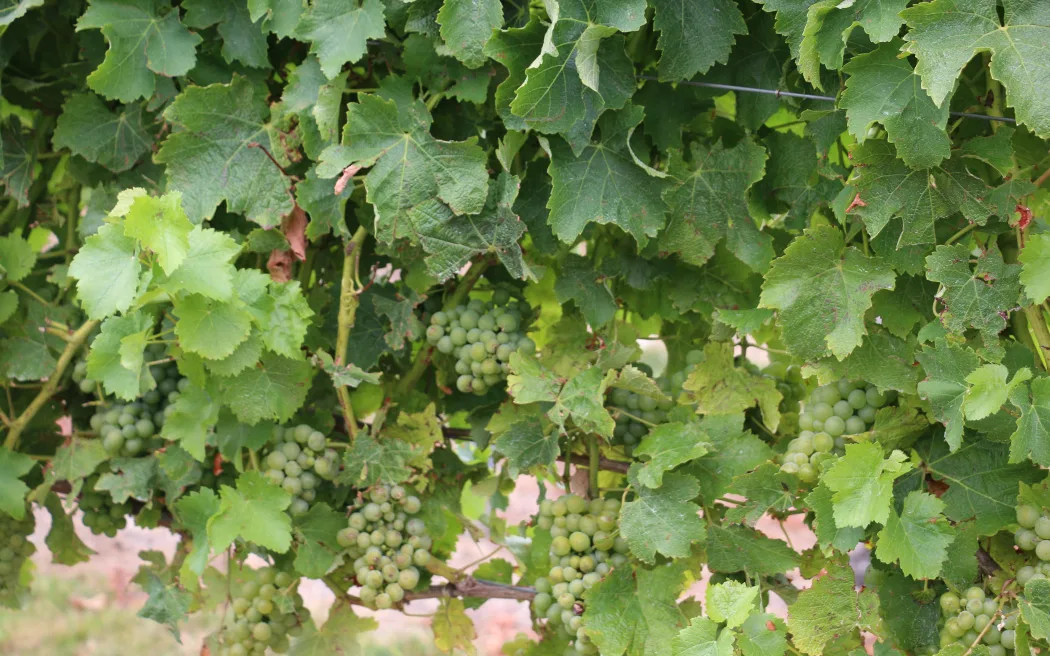


 Waimea Estates is one of Nelson’s larger producers with over 140 hectares of their own vineyards. The cool climate and alluvial soils of Nelson’s Waimea plains combined with the highest sunshine hours in New Zealand allow vibrant, fruit-focused wines to be made.


